
[August 17 to August 23, 2026]
Most of this week’s tokenization progress happened in the easier parts of finance: deposits, money-market funds, bonds and listed equities.
These assets are already standardized, priced and easy to transfer.
Real estate is a harder test. Every asset is different. Valuation is periodic. Ownership sits inside local title and legal systems.
This week shows how quickly the infrastructure is improving. It also shows where the gaps still are.
The question remains: What moved closer to enforceable ownership, and what did not?
TL;DR
Swift and Euroclear moved tokenized cash and debt into live institutional use.
Clearstream pushed custody, settlement and collateral further onchain.
Franklin moved tokenized funds closer to conventional portfolios.
Tokenized credit gained new collateral and liquidity use cases.
Tokenized equities reached $2.8bn, while ownership models kept diverging.
Real estate still depends on title, valuation and jurisdiction.
RWA Onchain: Weekly Snapshot
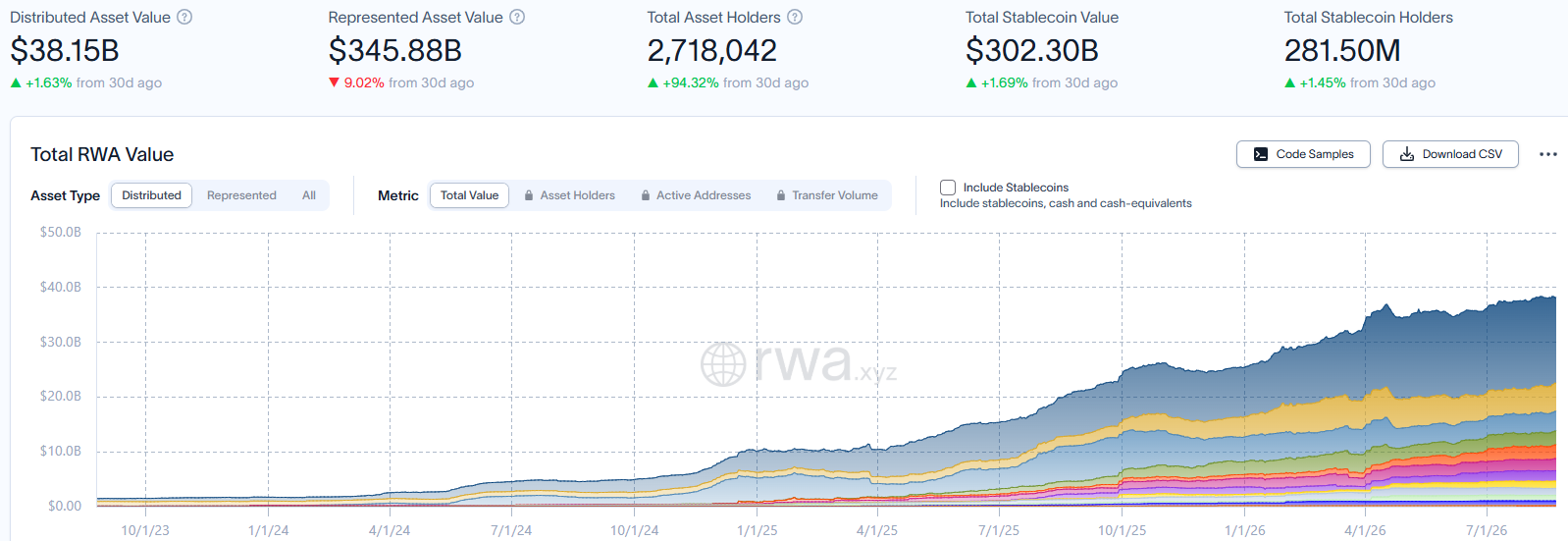
Distributed onchain RWA value: $38.2bn
Previous week: $38.1bn
Stablecoin value: $298.1bn
Onchain RWA value was again largely unchanged week on week, holding above $38bn.
(Source: rwa.xyz.)
Institutional RWA & Tokenization
1. Swift and Euroclear Move Into Live Institutional Use
HSBC and Standard Chartered completed the first live cross-border interbank transaction on Swift’s blockchain-based ledger.
The transaction connected HSBC’s Tokenised Deposit Service with Standard Chartered’s tokenized-deposit infrastructure, with Swift coordinating the payment before final settlement through existing banking systems.
It follows the earlier 17-bank pilot.
This time, a pilot became a live transaction.
Standard Chartered also issued $200 million of digitally native notes through Euroclear’s Digital Financial Market Infrastructure, becoming the first G-SIB and first UK issuer to use the platform for its own issuance.
The notes remain connected to Euroclear’s existing settlement and servicing infrastructure, and Standard Chartered has applied for them to trade on the London Stock Exchange’s International Securities Market.
Together, the two developments show tokenized cash and digital securities beginning to connect with established institutional market infrastructure.
(Sources: Standard Chartered, Swift transaction; Standard Chartered, Euroclear issuance; Euroclear.)
2. Franklin Templeton Pushes BENJI Into Traditional Funds
Franklin Templeton is preparing to use its Franklin OnChain U.S. Government Money Fund inside conventional ETFs and mutual funds.
The move follows an SEC no-action letter covering the structure.
Franklin could use the tokenized money-market fund for cash management and potentially collateral, subject to individual fund approvals.
The important shift is distribution.
Tokenized assets can start sitting inside products investors already use, without requiring a separate blockchain-native investment decision.
That brings tokenization deeper into traditional asset management.
(Sources: SEC; Bloomberg via WealthManagement.)
3. Clearstream Pushes Beyond Issuance
Clearstream is preparing to tokenize parts of its roughly €22 trillion custody book, with initial issuances expected later this year.
The Deutsche Börse subsidiary is focusing first on fixed income and structured products while building across issuance, settlement, custody and collateral.
The €22 trillion figure reflects custody scale, not the amount likely to be tokenized.
What matters more is the order.
Fixed income and structured products already have standardized terms and established pricing.
Assets that need individual valuation, title registration and jurisdiction-specific ownership checks are further back in the queue.
Custody infrastructure alone does not solve those problems.
(Source: Ledger Insights.)
4. Tokenized Credit Gets Collateral and Faster Liquidity
Securitize and Neuberger launched HINC, a tokenized high-yield fund across Avalanche, Ethereum, Solana and Sui.
The strategy focuses mainly on high-yield corporate bonds, alongside CLOs and leveraged loans. Neuberger’s fixed-income platform oversees more than $230 billion.
Securitize has also proposed adding HINC to Aave Horizon as collateral, where eligible users could borrow stablecoins against the fund if governance approves it.
Separately, Centrifuge and Symbiotic introduced T+0 USDC liquidity for three tokenized institutional funds representing around $1.6 billion in AUM.
Their normal redemption periods range from T+1 to T+5. Symbiotic’s Liquid Lane gives eligible investors another way to exit into USDC through an RFQ system.
These developments deal with what happens after issuance: financing and exit.
Putting an asset onchain does not create a market around it by itself.
(Sources: Neuberger; Aave Governance; Centrifuge; Symbiotic.)
5. Tokenized Equities Reach $2.8 Billion as Ownership Models Diverge
Tokenized equities reached roughly $2.8 billion, bringing their share of the RWA market to around 15%, about three times where it started the year.
RWA transfer volume also rose to around $20 billion in August, up from $9 billion the month before.
Ondo, Binance bStocks and xStocks now account for roughly 77% of the tokenized-equity market.
The headline growth hides an important difference.
Some products give investors synthetic exposure to a share. Others aim to put the security itself onchain with shareholder rights attached.
Two products can trade almost identically and still give the holder very different claims.
Synthetic exposure and an onchain security are different instruments.
The market has grown quickly enough that this distinction will become harder to ignore.
(Source: The Block.)
6. The SEC Starts Drawing Clearer Legal Boundaries
The SEC proposed Regulation Crypto Assets, a new framework for crypto-asset offerings in the U.S.
The proposal includes new fundraising exemptions and tries to clarify when an investment contract tied to a crypto asset can cease to exist.
It remains a proposal and will go through public consultation.
For tokenized securities, the legal question sits alongside the technical one.
Investors need to know what the token represents, which rights come with it and where those rights can be enforced.
Without that clarity, faster settlement does not solve the ownership problem.
The Hard Case: Real Estate
1. China Shows Why Legal Rights Matter
More than $148 billion of non-residential property is estimated to sit on land with 20 years or less remaining on its lease.
China’s property downturn is increasingly about more than developer defaults.
Falling commercial values and land-use rights are becoming bigger issues. For investors, the building itself is only part of the asset.
Tenure, jurisdiction and enforceable ownership rights affect the value too.
A digital record does not remove those questions.
Legal structure is part of the asset.
(Source: Bloomberg.)
2. Hudayriyat Shows How Complex Large Real Assets Can Be
Hudayriyat Island recorded AED 19 billion in residential sales in the first half of 2026, around 27% of Abu Dhabi’s total residential sales value.
Saadiyat Island followed with AED 13.3 billion, while Al Reem and Al Maryah combined for AED 10.5 billion.
Large master-planned developments can combine housing, hospitality, retail and infrastructure across different contracts, revenue streams and ownership structures.
That complexity remains even when investment interests move onchain.
The underlying rights still have to be defined clearly.
(Source: Emirates News Agency.)
OneAsset POV
A lot moved this week, but mostly in assets that markets already know how to price, hold and transfer.
Real estate is harder.
Before it can become more usable onchain, the basic questions still have to be answered: what exactly do I own, how is it valued, and which law protects that ownership?
That is where real work begins.
For real estate, the asset comes before the token. Ownership, valuation and investor rights have to be defined before blockchain can make those interests more transferable, financeable or useful across financial markets.
The legal claim has to be as clear as the token itself.
A note on currency
Figures are reported in the currency of the transaction, with a US dollar equivalent in parentheses on first mention. Conversions use mid-market rates as of August 16, 2026, and are rounded.
Disclaimer
This summary is based on verified, publicly published industry sources and does not constitute investment, legal, or financial advice. While we strive for accuracy and timeliness, digital asset projects, regulatory frameworks, and market data may change rapidly following the date of publication.
About OneAsset
OneAsset is a Dubai-based real-world asset tokenization company building compliance-first infrastructure for institutional commercial real estate, operating within the VARA regulatory framework. Purpose-built for the full institutional lifecycle of tokenized real estate, OneAsset supports the programmatic systems required for compliant issuance, automated servicing, transparent reporting, strict ownership controls, transfer rule enforcement, and asset lifecycle management. The company brings the structural discipline of traditional commercial real estate into onchain market infrastructure, delivering regulated deployment readiness from day one.
Join our Waitlist for Launch Access | Read the Capital Stack Archive
Connect with us: X | Website | LinkedIn | Instagram
Join our newsletter for insights on RWA trends,
regulatory updates, and our journey to bridge
TradFi trust with Web3 transparency.