The New Capital Stack #47: The Regulated Stack Is Filling In
Tokenized funds moved deeper into Europe, banks pushed deposits onchain, and real estate entered the same institutional stack.

[August 3 to August 9, 2026]
Last week, Project Agorá showed that tokenized commercial-bank and central-bank money could settle real value across borders.
This week, institutions started building further up the stack.
BlackRock expanded tokenized money-market funds in Europe. Schroders received approval for a tokenized fund share class. Wells Fargo outlined plans for tokenized corporate deposits. South Korea created a dedicated unit around tokenized government bonds.
And in Saudi Arabia, Tether chose institutional real estate as the starting point for its latest tokenization push.
The direction is becoming clearer: tokenization is moving from isolated pilots toward regulated financial infrastructure.
The question now isn’t whether we can tokenize an asset but whether the systems around it are strong enough for institutions to actually use and own it at scale.
TL;DR
BlackRock expanded its tokenized money-market fund strategy in Europe, reinforcing cash products as the institutional entry point for tokenization.
Schroders received Irish regulatory approval for a tokenized USD money-market fund share class supported by JPMorgan Kinexys.
Wells Fargo plans tokenized USD and GBP deposits for corporate clients, with programmable and round-the-clock transfer capabilities.
The Bank of Korea created a dedicated tokenization unit focused on government bonds, wholesale CBDC and tokenized deposits.
Tether is bringing Hadron into Saudi Arabia, starting with institutional real estate.
Broadridge reported growing demand for tokenized-securities infrastructure, particularly around administration, governance and investor communications.
US market-structure legislation moved into September, leaving broader digital-asset classification questions unresolved.
APAC commercial real estate continues to recover, with capital concentrating in markets and sectors showing stronger income growth.
RWA Onchain: Weekly Snapshot
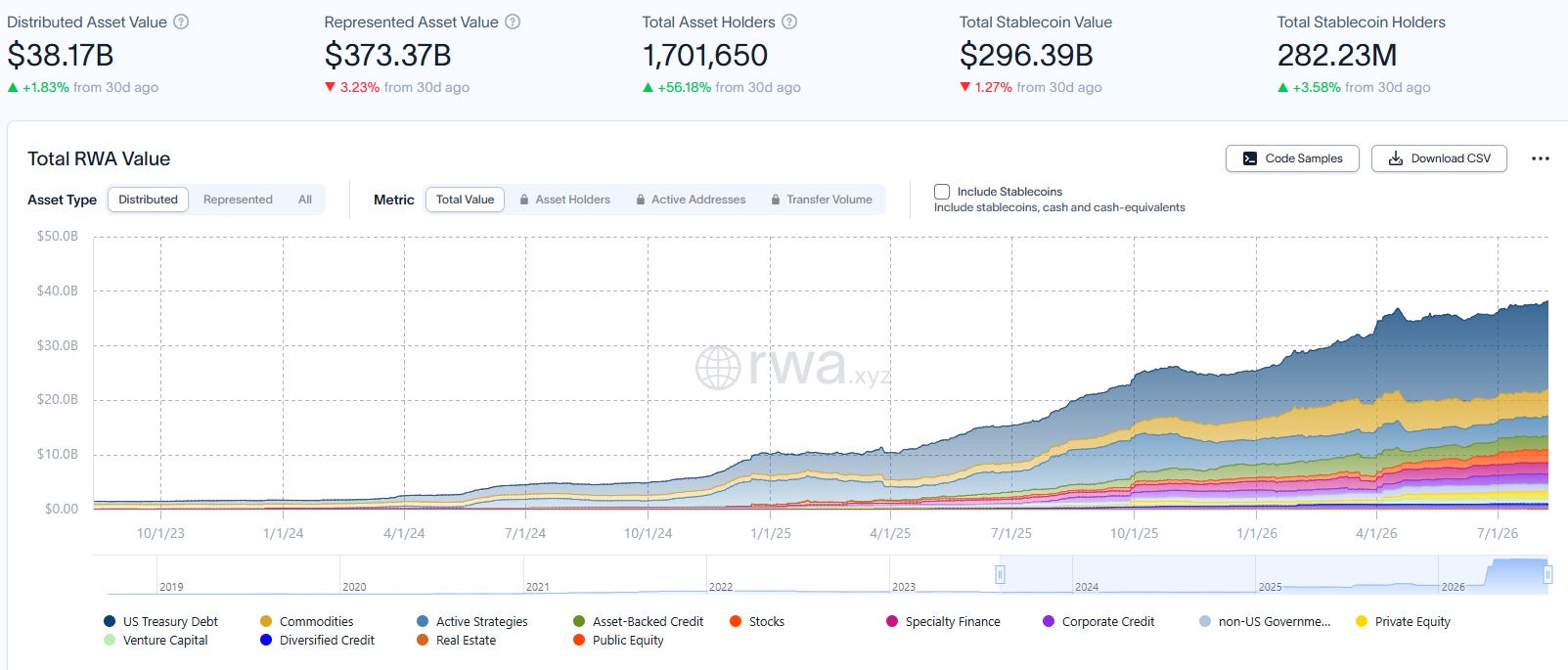
Distributed onchain RWA value reached approximately $38.2bn, up from $37.23bn a week earlier.
That represents roughly $1bn of additional distributed value in a week, while stablecoins remain much larger at around $296bn.
The more important signal this week is institutional participation.
BlackRock, Schroders, JPMorgan, Wells Fargo and central banks are increasingly integrating tokenization into existing financial products and payment infrastructure.
That changes where the bottleneck sits.
Issuance technology is becoming easier to access. The harder work is making the underlying asset compliant, transferable, administratively efficient and legally enforceable.
Institutional RWA & Tokenization Update
1. Tokenized Cash Keeps Leading Institutional Adoption
BlackRock expanded its tokenized money-market fund strategy into Europe, while Schroders received approval from the Central Bank of Ireland for a tokenized USD money-market fund share class.
Both developments follow the same pattern.
Institutions are starting with products that already have established custody, valuation, redemption and regulatory frameworks.
That makes money-market funds particularly suitable for tokenization: the underlying product does not need to be reinvented, only the infrastructure around its distribution and settlement.
It is one reason cash-equivalent products and government debt continue to dominate institutional tokenization.
(Sources: CoinDesk; Financial News London.)
2. Wells Fargo Moves Tokenized Deposits Toward Production
Wells Fargo plans to introduce tokenized USD and GBP deposits for corporate and commercial clients this fall.
The system is expected to support programmable transfers and settlement outside traditional banking hours.
The announcement follows Project Agorá’s real-value tests involving tokenized commercial-bank deposits and central-bank reserves.
The difference is important.
Agorá demonstrated that the model can work. Wells Fargo is moving toward making similar infrastructure available as a commercial banking service.
For tokenized capital markets, that matters because continuously traded assets ultimately need settlement infrastructure that can operate beyond traditional payment windows.
(Source: The Wall Street Journal.)
3. South Korea Builds Around Tokenized Government Bonds
The Bank of Korea created a dedicated asset-tokenization unit within its Digital Currency Office.
Its work includes tokenized government bonds, wholesale CBDC and tokenized bank deposits.
The broader goal is not simply to put bonds onchain, but to connect securities and settlement money within the same infrastructure.
Government bonds are a natural starting point because they are highly standardized and widely used as collateral.
If tokenized bonds and tokenized money can operate together, the use case expands beyond faster settlement into programmable collateral and more efficient capital movement.
(Source: Ledger Insights.)
4. Tether Brings Hadron Into Saudi Real Estate
Tether is expanding its Hadron tokenization platform into Saudi Arabia, with institutional real estate as the initial focus.
The model could later extend into infrastructure and energy finance.
This is a notable step because real estate presents a much more complex lifecycle than Treasuries or money-market funds.
Ownership structures, valuations, income distributions, transfer restrictions and ongoing asset servicing all remain relevant after issuance.
The opportunity is therefore not simply to tokenize the property, but to maintain those requirements throughout the asset’s life.
Saudi Arabia is becoming an important market to watch as tokenization becomes more closely tied to regulated real-estate and infrastructure development.
(Source: CoinDesk.)
5. Broadridge Highlights the Infrastructure Layer
Broadridge reported growing demand around tokenized-securities workflows, including governance, investor communications and administration.
That is a useful reminder of how institutional tokenization is developing.
The technology may automate parts of the process, but regulated financial products still require administration, ownership records, compliance controls and investor servicing.
Tokenization changes how those functions are carried out rather than eliminating the need for them.
As institutional adoption grows, this operational layer is likely to become more important.
(Source: Ledger Insights.)
6. US Market Structure Moves to September
The US Senate did not complete digital-asset market-structure legislation before the August recess.
The debate is expected to continue in September.
For RWAs, the key issue is regulatory classification and the treatment of different tokenization models, intermediaries and trading venues.
That uncertainty helps explain why institutional adoption remains concentrated in products with established legal frameworks, including money-market funds, bank deposits and government securities.
Regulatory clarity still shapes which asset classes can scale first.
(Source: Financial Times.)
Real Estate Pulse
1. APAC Capital Is Returning Selectively
Asia-Pacific commercial real-estate investment continued to recover in the first half of 2026, but capital remains selective.
Investors are concentrating on markets where rental growth is more visible, including Tokyo, Sydney and Brisbane.
The recovery is therefore less about broad exposure to real estate and more about income quality.
Where yield compression is limited, investors need stronger rental growth and clearer cash-flow visibility to justify pricing.
(Source: CBRE.)
2. TPG Acquires $628m US Industrial Portfolio
TPG Angelo Gordon acquired a $628m industrial portfolio comprising 53 buildings and approximately 5.4 million square feet across seven US states.
Around three quarters of the portfolio is concentrated in the Southeast, and occupancy stands at roughly 87%.
The transaction reinforces institutional demand for industrial assets with diversified tenant bases and relatively visible operating cash flows.
For tokenization, the implication is similar: better distribution technology can expand access, but the quality of the underlying asset remains the starting point.
(Source: TPG.)
3. Student Housing Continues to Attract Capital
TPG and Madison International Realty formed a partnership around German student-housing and micro-living platform Home & Co.
The platform operates 19 locations with more than 3,500 beds across Berlin, Frankfurt, Munich and Stuttgart.
Student housing continues to attract institutional capital because structural supply shortages and recurring demand create relatively predictable operating fundamentals.
That makes the sector increasingly relevant for structured real-estate investment products, including future tokenized formats.
(Source: TPG.)
4. Data Centres Move Further Into Capital Markets
Data-centre financing is increasingly becoming a credit-market theme alongside its role as a real-estate sector.
Investors can now access AI infrastructure through bonds tied to data-centre development rather than relying only on property ownership or hyperscaler equities.
The structure is relevant to tokenization because data centres combine real estate, infrastructure and long-duration contractual cash flows.
Standardized financial claims around those assets may ultimately be easier to bring onchain than direct ownership of the underlying property.
(Source: The Wall Street Journal.)
OneAsset POV: The Middle Layer Is Becoming the Bottleneck
The past two weeks show how quickly the institutional tokenization stack is developing.
Project Agorá demonstrated tokenized bank-money settlement.
BlackRock and Schroders are expanding tokenized fund products.
Wells Fargo is preparing tokenized deposits.
South Korea is looking at government bonds and settlement money together.
And Tether is pushing further into institutional real estate.
The pattern also shows why some asset classes are moving faster than others.
Money-market funds and government bonds already have standardized legal, valuation and operational frameworks. Tokenization can improve their infrastructure without first solving the asset itself.
Commercial real estate is more complex.
The asset continues to generate operational requirements long after issuance, from ownership records and distributions to transfer controls, reporting, servicing and valuation.
That is where the next infrastructure challenge sits.
The industry is getting better at bringing assets onchain.
The harder part is maintaining institutional-grade ownership once they are there.
For commercial real estate, that middle layer will determine whether tokenization becomes more than a new distribution format.
It is where compliant ownership, asset operations and settlement ultimately have to meet.
A note on currency
Figures are reported in the currency of the transaction, with a US dollar equivalent in parentheses on first mention. Conversions use mid-market rates as of August 9, 2026, and are rounded.
Disclaimer
This summary is based on verified, publicly published industry sources and does not constitute investment, legal, or financial advice. While we strive for accuracy and timeliness, digital asset projects, regulatory frameworks, and market data may change rapidly following the date of publication.
About OneAsset
OneAsset is a Dubai-based real-world asset tokenization company building compliance-first infrastructure for institutional commercial real estate, operating within the VARA regulatory framework. Purpose-built for the full institutional lifecycle of tokenized real estate, OneAsset supports the programmatic systems required for compliant issuance, automated servicing, transparent reporting, strict ownership controls, transfer rule enforcement, and asset lifecycle management. The company brings the structural discipline of traditional commercial real estate into onchain market infrastructure, delivering regulated deployment readiness from day one.
Join our Waitlist for Launch Access | Read the Capital Stack Archive
Connect with us: X | Website | LinkedIn | Instagram
Join our newsletter for insights on RWA trends, regulatory updates, and our journey to bridge TradFi trust with Web3 transparency.