The Liquidity Myth
Liquidity is the last thing to arrive, and the first thing everyone promises.


By early 2026, tokenization will have moved past the proof-of-concept stage. European issuers have placed close to €4 billion in DLT-based fixed income since 2021, a figure the Association for Financial Markets in Europe ties to a market that now includes the first digital sovereign debt issued by EU member states. In the United States, a no-action letter from the SEC and a Nasdaq rule change have opened a path for tokenized Russell 1000 stocks, major-index ETFs, and US Treasuries to trade with the same rights as their traditional counterparts, with a DTCC pilot expected in the second half of the year.
That progress settles one thing and exposes a harder one. Representing an asset as a digital token is close to being solved. Making that token behave like a functioning financial instrument, one that can be issued, transferred, settled, serviced, and financed inside a regulated market, is where the work now sits.
The gap is easy to underrate. A tokenized building is not a market. A market is a set of rules, participants, settlement guarantees, and legal protections that let an instrument move and hold value. Four things decide whether tokenized assets clear that bar: market design, financial workflows, hybrid integration, and liquidity.
1. Market design: can it scale?
Institutional attention has shifted from the token to the environment around it. The interest now is in full market design, where tokenized assets can be issued, transferred, settled, and serviced within a regulated framework rather than in a standalone pilot.
The regulatory frameworks reflect this. The EU’s MiCA and DLT Pilot Regime are built to enable market ecosystems, not to bless individual instruments. In March 2026, the Eurosystem began accepting DLT-based assets as eligible collateral for its credit operations, a signal that the plumbing is being wired into existing central bank infrastructure, not built beside it.
Two developments make the point concrete. The DTCC framework taking shape across 2025 and 2026 is designed so that tokenized securities keep the same rights and protections as their traditional versions, which is the condition institutions actually care about. And the ECB’s 2024 exploratory work, in which 64 participants across nine jurisdictions settled close to €1.6 billion in central bank money, tested the settlement layer rather than the issuance layer.
Where each part of the stack sits today:
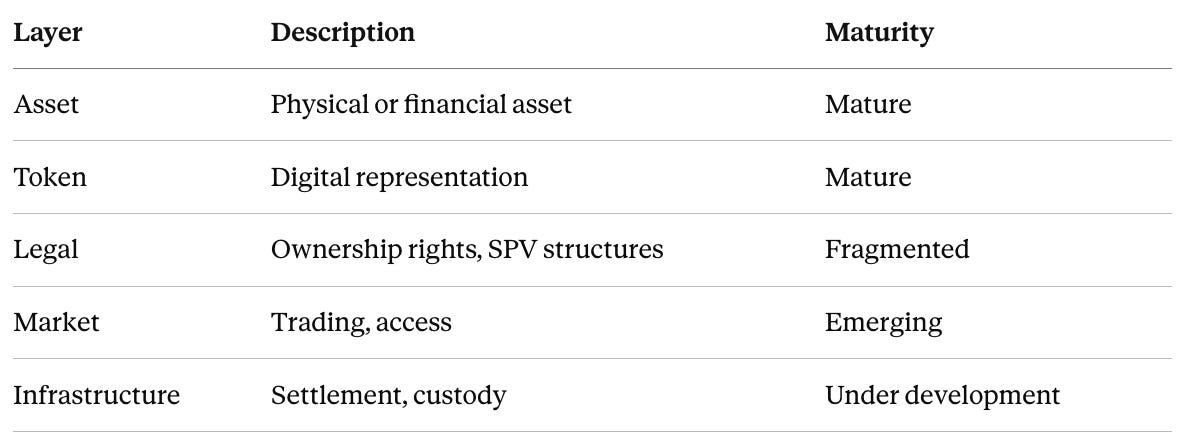
The two mature rows are the ones everyone talks about. The three unfinished rows are the ones that decide scale.
The bottleneck is not whether an asset can be tokenized. It is whether the legal, market, and settlement layers beneath it are built out enough to carry institutional volume.
2. Financial workflows: Can they function?
Tokenization touches the whole life of an asset, not just its birth. Issuance is one step. Servicing, collateral use, reporting, and settlement are the steps that consume institutional time and cost, and those are where the operational case is made.
The institutional driver is efficiency. Less reconciliation, automated servicing, faster settlement. Smart contracts let coupon payments, compliance checks, and reporting run inside the instrument rather than alongside it, which is where the reduction in manual overhead comes from.
What that looks like against the traditional process:
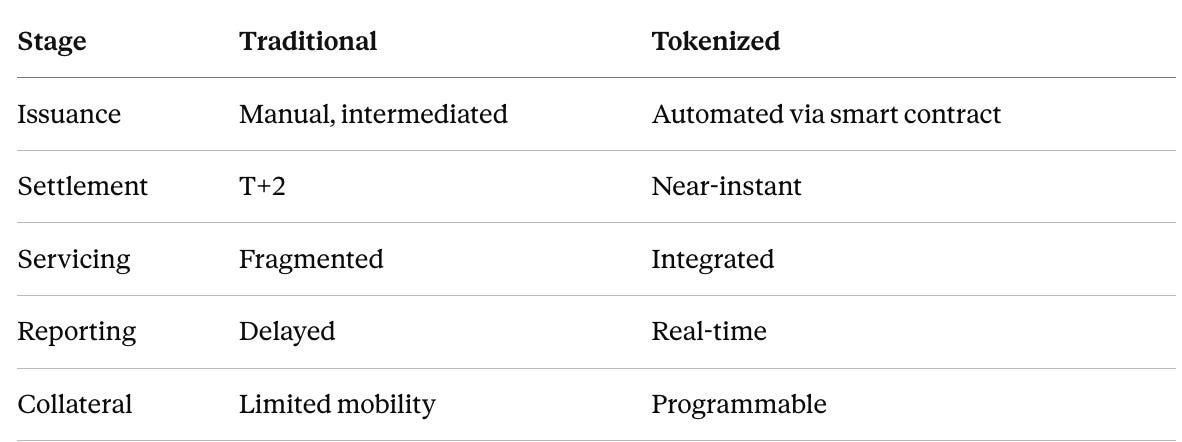
Tokenized money-market funds show the pattern in production. BlackRock’s BUIDL and Franklin Templeton’s tokenized fund are real, regulated products whose value is not that they exist onchain but that they slot into issuance, servicing, and distribution as one workflow. The DTCC and Chainlink work on fund lifecycle automation points at the same target: the post-issuance operations, not the issuance event.
The value sits after issuance. Servicing, reporting, and collateral mobility are what move an institution from watching to allocating.
3. Hybrid systems: Can they integrate?
The early framing had tokenization replacing traditional finance. The build that is actually happening is integration. The Bank for International Settlements and central banks are constructing hybrid systems where tokenized assets sit alongside central bank money, commercial bank systems, and existing settlement rails.
Several forms of digital money will coexist rather than compete to the death. Stablecoins, tokenized deposits, and wholesale central bank digital currencies each cover a different role. Final settlement still leans on central bank money, which is why interoperability, not replacement, is the design constraint.
The ECB’s two-track plan illustrates it. Pontes, the near-term track, links DLT platforms to the TARGET settlement system and is slated for a pilot in the third quarter of 2026. Appia is the longer-term ecosystem work. Both assume the traditional core stays and the tokenized layer connects to it.
Layer Role Traditional finance Trust, regulation, custody Tokenized layer Efficiency, programmability Bridge layer Interoperability, compliance
BIS experiments suggest integration needs incremental upgrades, not a rebuild. That is the good news for issuers: you are connecting to infrastructure that already commands institutional trust, not asking anyone to abandon it.
Trust lives in the traditional layer. Efficiency lives in the tokenized layer. The value is in the bridge between them, and the bridge is a compliance problem before it is a technology one.
4. Liquidity: Can it be used?
The most durable misconception in this market is that tokenization creates liquidity on its own. It does not. Liquidity shows up when the structure is sound, participants are active, and trust is established. Plenty of tokenized assets are technically tradable and still barely trade.
Tokenization improves efficiency. It does not guarantee a market. What it can do is widen the ways an asset becomes useful, and right now, the strongest of those is collateral. Tokenized treasuries and money-market funds are being used far more as collateral in repo and financing than as instruments people trade back and forth, and the ECB has run repo trials on DLT to test exactly that use.
What actually drives whether a tokenized asset gets used:
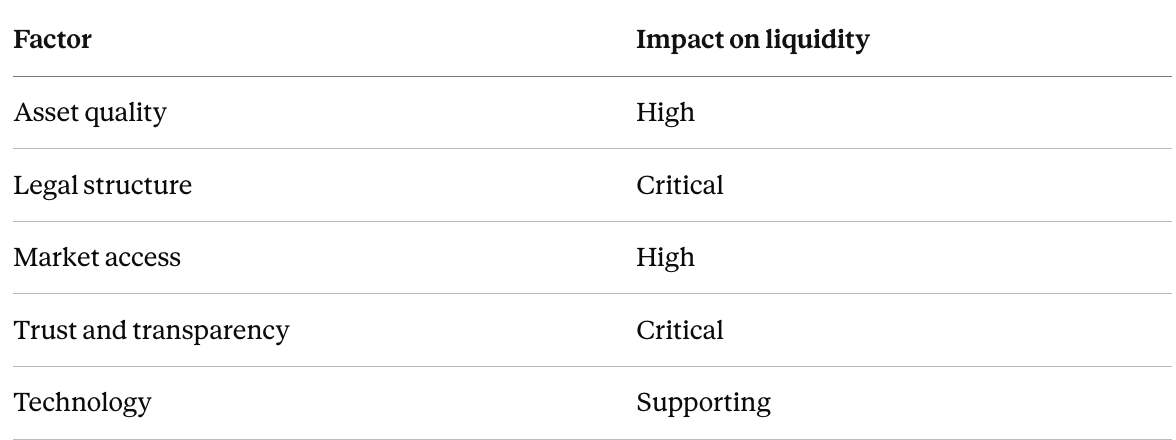
Technology sits at the bottom of that list on purpose. Jurisdictional fragmentation and operational barriers slow adoption far more than any protocol limitation does. Settlement finality and risk frameworks are what institutions underwrite against, and those are legal and operational questions, not engineering ones.
Liquidity is an outcome, not a feature. It follows structure, participation, and trust. A token is a claim on all three, not a substitute for any of them.
The through-line
Read the four together, and one picture holds. Market design sets whether assets can scale. Workflows determine whether they can function. Hybrid integration determines whether they can connect to the system that already holds the trust. Liquidity determines whether they get used at all.
The center of gravity in tokenization has moved from creation to operation. The instruments exist. What decides the next phase is how they behave once they are inside real financial systems: how they settle, how they are serviced, how they connect, and whether anyone can actually put them to work.
That is a harder problem than issuance, and a more interesting one. It is also a problem worth building for.
This document is institutional research prepared by OneAsset Research Team for information only. It is not investment, legal, or tax advice, and it is not an offer or solicitation. Market projections cited are those of named third parties and are not forecasts by OneAsset. Figures are drawn from industry sources and may change.
Join Us and Build
OneAsset exists to make premium real estate open, fractionalized, and compliant; to take the most resilient asset class in history and connect it to the borderless economy of tomorrow.
Follow us on socials for updates on the future of real estate onchain, and join our waitlist to be part of the launch.
X | Website | LinkedIn | Instagram